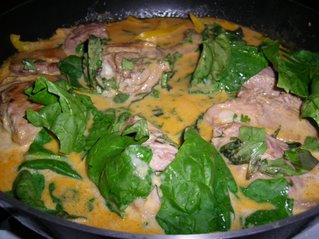
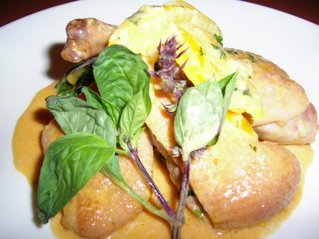
Showing posts with label Poultry. Show all posts

Monday, April 02, 2007

Jungle Curry


I'd always thought that Jungle Curry was an unbelievably hot curry, I mean, even the name suggests that the curry would include ingredients only found in the deepest, darkest depths of an Asian Rain forest. I was surprised to find that this was by no means the case. It turns out that Jungle Curry is my new favourite Curry. It's quite possible that there are many hotter and spicier recipes for Jungle Curry out there, but this one which I found in Geoff Lindsay's Chow Down Book, has some of the most interesting Asian Flavours that I've tasted.

Start off by making your curry paste. Bash up some white pepper corns in a mortar and pestle


A lot of the flavour in this curry comes from the Green Peppers in the paste. There are a couple of chillies in here, just 2 long green chillies, not too spicy. Similar to a normal Green Curry Paste, there's also Shallots, Garlic, Ginger and Galangal. Books always say it's better to bash up your pastes in a mortar and pestle, but to tell you the truth I'm over that. I have quite a big Mortar and Pestle and even then it's just all too messy. It's so much easier just to put all your ingredients into the blender or a food processor and just whizz it up. It might be less traditional, but it's much easier and less messy - that's what we want, isn't it!?


Mix some of the paste with the chicken and you can marinate it for a little bit if you like, but I just fried up the chicken once it was covered in some paste. Reduce some coconut milk in a saucepan and add more paste, now you've got your sauce. Have your beans ready and blanched. Stir fry some egg plant, your beans and the chicken in some peanut oil and add your sauce, and simmer for a few minutes.


Now you can add the magic ingredient, the fresh Green Peppercorns. The Peppercorns is where this dish gets it's slight spicyness from. It's so different to the heat from chillies, which is what sets this curry apart from others. I tried a few supermarkets before I found these babies, I found them at Carlton Safeway, however, I'm sure you could find them at a good Asian grocery store.

Serve the curry in bowls with some Jasmine Rice and garnished with some Coriander. Seriously, if you've never had this type of Curry before and you're into making curries from scratch at home, give one a go - it's the best!

Monday, March 19, 2007

Ezard's Red Duck Curry with Lychees - My 50th Post...Yaay!


Well, it's my 50th post, so I thought I'd celebrate with my favourite food by my favourite Melbourne chef, Teage Ezard. One of my first posts here was my attempt at re-creating Geoff Lindsay's Roast Red Duck Curry, even though someone had ripped the actual red curry paste recipe out of the library book. This time, I've found a similar recipe in Ezard's lastest book Lotus - Asian Flavours. The method for cooking the duck in this one is quite different as it's steamed and then deep fried.
Unfortunately, I won't be giving you the recipe here, because you'll have to buy the book for that, but check out the method and if you like the look of the final product, you might like to try it yourself.

First you'll need to dry roast your spices - coriander, cumin, star anise, nutmeg and white peppercorns. Once roasted, you'll need to bash them up in a mortar and pestle and coat your duck meat in the spices. You then need to steam the duck pieces until cooked.


Once the duck has been steamed, you'll need to deep fry the duck until the skin has gone nice and crispy.


You then need to make your Red Curry Paste by bashing up all your ingredients in a Mortar and Pestle, which includes things like chillies, garlic, ginger, galangal, coriander roots, etc.


You then need to fry your paste in a wok for about 10 mins, until its fragrant... you'll be able to tell when it's ready because it smells AMAZING!


Mix in coconut cream and your duck and simmer for a few mins until the duck has heated through. Then you can mix your Lychees through and check the curry for seasoning, adding lime or fish sauce if needed. Now all that's left to do is plate up your masterpiece and enjoy the fantastic zingy flavours that bounce around your mouth like golf balls at a driving range!
The curry is a bit spicy, but the sweetness of the Lychees balances this out beautifully. This is almost exactly like the Red Duck Curry we had when were in Sydney at Papaya in Cremorne .


Monday, December 04, 2006

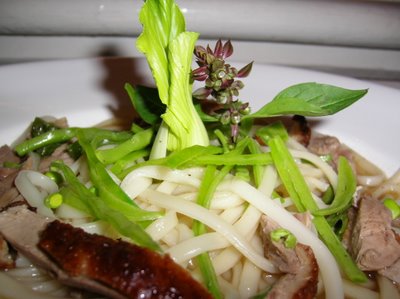
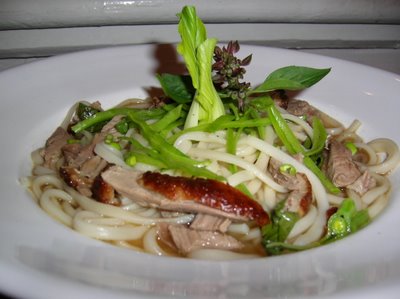
My Own Chinese Five Spiced Duck and Noodle Soup

After my visit to Ezard's last week and the amazing dumplings in duck broth I had for an entree, I've been in the mood for duck - I think it's knocked yellow curry from the top spot on my favourite foods list. So, yesterday my Mum and I put together Peking Duck for dinner for my Dad's birthday. As good as the Peking duck was, I won't be blogging about it, as I forgot to take my camera over to my folk's house. But, with the left over carcass of barbeque duck, I decided to attempt my own little version of Ezard's duck broth.
I literally have just finished my second bowl of the soup that I made and I was so impressed with myself that I had to write a post about it right away. I'm sure there's probably many recipes out there similar to this, but this is one I made up on the spot.


Ingredients:
2 tablespoons Chinese Five Spice Powder
1 Red Onion, roughly chopped
2 cloves Garlic, roughly chopped
1 knob Ginger, grated
2 Birds Eye chilies, finely chopped
1 Carrot roughly chopped
2 stalks of Celery roughly chopped
1 Duck carcass, most of meat removed
Handful of Thai Basil Leaves
2 bunches of Hakubaku Organic Udon Noodles (these are my favourite)
1 bunch of baby Bok Choi, stalks finely sliced, leaves kept whole
Light Soy sauce to season
Finely julienned snow peas to garnish


Method:
Gently sautee your carrots, celery and onion until soft in some olive oil.
Add garlic, chilli, ginger and lightly fry for a few seconds.
Add your Five Spice powder and fry for another few seconds, being careful not to burn the five spice
Add your duck carcass and cover with cold water.
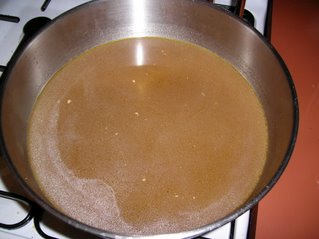
Slowly bring to the boil and then turn heat down to a very gentle simmer, just so it's ticking over. Leave this to simmer for about 2 hours, making sure you remove any scum that may build up on the top of the liquid. You may also need to top up the water from time to time if it reduces.


After 2 hours have elapsed, you can drain the stock through a colander, sieve, etc, into a bowl, so you're left with the liquid. You don't need the bones, vegies, etc. However, you can pick the remaining meat from the bones, to add to your finished dish.
You can now taste your broth for seasoning and add some soy sauce as required.
Towards the end of the 2 hours, you can cook your noodles according to packet instructions and also steam your Baby Bok Choi above your noodles - the greens will only take a couple of minutes to steam.
Bring the drained soup back to the boil and add your picked meat and a handful of the basil leaves.
Place some cooked noodles in the bowl and ladle some of the meat, basil and broth, over the top.
Garnish with some of the chopped snow peas or spring onions.


You could could always add a few shitake mushrooms to the broth, but unfortunately I didn't have any on hand. Ok, so it's not quite an Ezard's dish, but hey, it's an Adski dish!

Monday, November 20, 2006

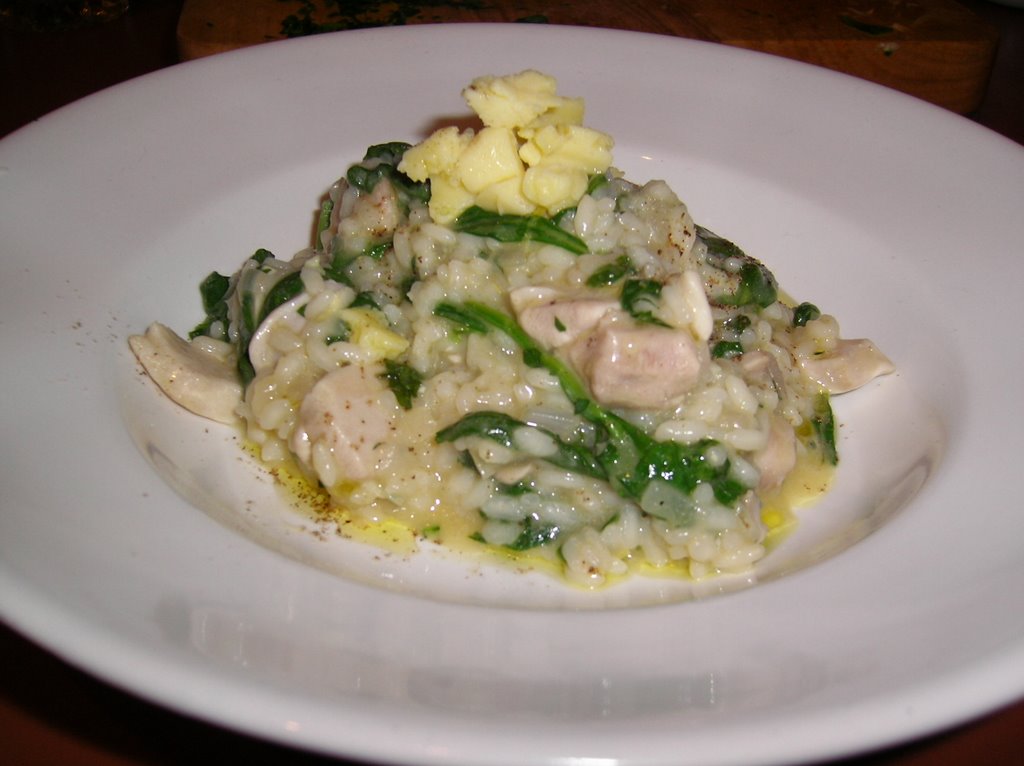
Chicken, Spinach and Lemon risotto with Yea Dairy Cheddar


Ok, so risotto isn't exactly summer food, especially on a 36c day, but I love it anytime. I guess it's the ingredients you add to it that can 'summer' it up.
Risotto was the first 'real' type of food that I ever learnt to cook. Once I learnt to cook it, I became obsessed with it for ages and still am!
Over time, I've learnt a few little tricks to making a good risotto. Some are plain obvious, but it suprising how many of my friends dont know them. So, here they are for your cooking pleasure;

  • Use proper risotto rice, ie Aborio, Carnaroli, etc. These grains are used because they have a high starch content, which is what makes a good risotto creamy. You really don't ever need to add cream, unless the recipe calls for it. I hate the fact that at I now have to ask restaurants what rice they use, because so many times I get risotto made with plain white rice. It's disgusting. I dont even consider that to be risotto.
  • Lightly dry fry your risotto rice, which will absorb the butter and olive oil in your fry pan after cooking your onion, garlic, etc. It will also help the rice to release it's starch, to make that lovely creamy risotto.
  • Use the best stock you can. Most of the flavour in risotto comes from your stock, so use home made or if you have to buy it, try to buy a gourmet version or at the very least the liquid stock. Powdered stock is usually full of MSG and salt, however vegetarians I know like to use Vegeta.
  • Keep your stock hot in a separate pot. This is so that when you add the stock to the rice, it doesn't lower the temperature of your pan and rice - making it take longer to cook and can often make the risotto gluggy.
  • Add the stock a ladle at a time, dont pour it all in at once.
  • Keep stirring. Some chefs say only stir occasionally, others say stir constantly. I say keep stirring for a couple of reasons. It helps release the starch from the grains, again giving you a creamier finished dish. It will also prevent your rice from catching on the bottom of the pan.
  • Cook your rice to Al Dente, meaning it's ever so slightly crunchy in the middle. When you rest your risotto, it will continue cooking slightly, and because you cooked it to al dente, this will ensure a perfectly cooked risotto.
  • When your risotto is done, drop some parmesan and a couple of knobs of butter and leave it to rest with the lid on for a few minutes. This helps to make your risotto less gluggy. Ideally you want a risotto that still has movement to it and will creep across the plate, rather than sitting in a big lump.

Wednesday, November 15, 2006

My Pad Thai

We're two weeks out of summer here in Melbourne and it's snowing in the outer suburbs! Well, even if the weather is terrible outside, there's no reason not to eat like the sun is shining. Nothing says freshness to me more than Thai food. Tonight I was late home from work, after riding my scooter home in the rain, so I thought I'd whip up a quick Pad Thai. For those of you who don't know, Pad Thai is basically a stir fry with rice noodles, but with that familiar Thai zing.

Like any good stir fry, it pays to be prepared. So get your noodles on the boil - probably about half a pack of rice stick noodles. These will take about 8 mins to cook - just enough time to cook the rest of the dish.


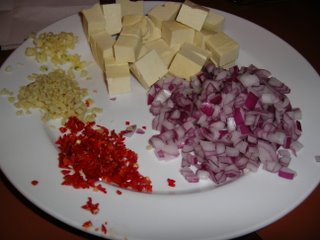
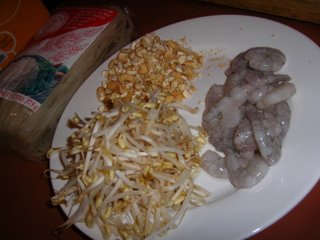
Finely chop an onion, 2 garlic cloves, a thumb size piece of ginger, and a chilli. Finely slice about 400g of pork, have about 100g of prawns peeled, crack a couple of eggs into a bowl and beat. Cut some firm tofu, about 3/4 block of stir fry tofu into blocks.


Heat up the some peanut oil in your wok and fry the eggs like an omlette, then remove and cut into strips and set aside.

Fry off some onion in the wok until softened and then add your pork. Once the pork has browned, add your garlic, chilli and ginger. Cook for another 30 seconds.


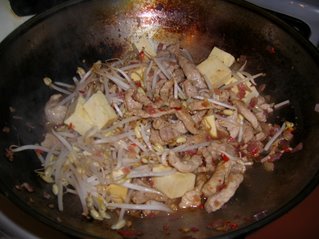
Add your prawns, bean shoots and tofu. In a bowl mix about 1/4 cup of fish sauce and 1/4 cup of lime juice with some palm sugar to sweeten. Pour this mixture into your wok. Keep tossing the food in the wok. Add your drained noodles and a couple of handfuls of chopped coriander.


Serve on a warm plate scattered with some chopped cashew nuts and some more fresh coriander.

Wednesday, November 08, 2006

Roast Duck in Red Curry

A few months ago I was reading one of those liftouts from The Age which had lots of Melbourne's "best of's". One of the things that caught my eye and seemed to stick in my mind was the 'Melbourne's best Curry' selection. It was the Roast Duck in Red Curry from Pearl. After reading the review on this dish, I wanted to try the curry there and then. But after getting onto Pearl's website and finding that the curry was $40, I decided to do what any good cook in my (broke) position would do. Cook it myself!


A quick trip to the North Melbourne library and I managed to find Geoff Lindsay's book (now out of print - I confirmed this with Pearl directly) 'Chow Down'. I had a quick look at the book and lucky for me- the recipe for the Duck Curry was there. However it seems someone liked the recipe that much, that they ripped out the page for the Red Curry paste for themselves. So, I improvised and jumped on the net and found an easy red curry paste recipe.
I'd never cooked duck before, or really eaten it for that matter. I had really eaten it once, but it was about 3am at China Bar in Russell St, in the City. I was a bit worse for wear and I think the duck was too.
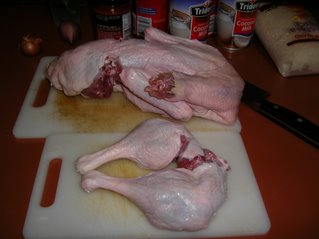
I got a small sized duck from the Vic Market, which cost about $12. The lady behind the counter told me it would easily feed 2 people.
Geoff's recipe called for the duck legs to be taken off the carcass and cooked seperately. Having never cooked or dealt with a dead duck before, I had to assume taking one apart was like dismantling a chicken. It wasn't too different and I don't think I did too bad a job.


Apparently, the breasts were meant to be kept attached to the carcass while being cooked and the drumsticks cooked in another tray. Both were to be cooked for 20 mins at 180c and then the breasts were meant to be removed and the oven turned down to 160c. The drumsticks should continue to be cooked for another 40 mins.
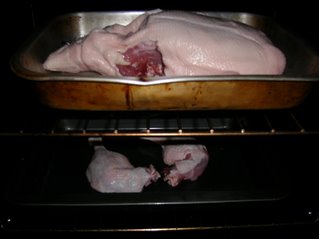
I did this, but because I'd never cooked duck before, I wasn't sure, but it didnt look like it was cooked to me. I decided to change the roast duck recipe to a pan fried recipe. I cut the breasts from the carcass and fried them for a couple of minutes until they were golden, in a frypan, with a little butter.


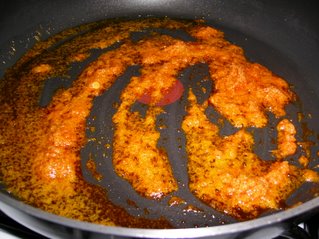
I then fried the red curry paste which I had previously bashed up in a mortar a pestle for a couple of minutes with a little olive oil.

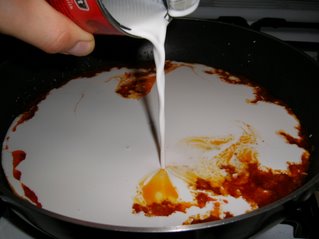
Once the paste was toasting nicely and was fragrant, I added a tin of coconut milk and let it simmer slowly for about 10 minutes, just to let it reduce a little. It's at that point you can taste it for seasoning, adding a little fish sauce if needed for saltiness or maybe some crushed palm sugar for sweetness.


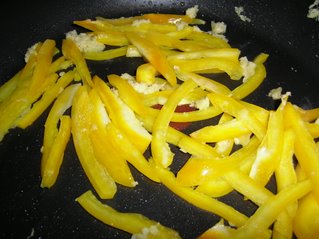
I then took the curry sauce out of the pan and sautee'd some yellow capsicum and some ginger until the capsicum has softened.

Then return the sauce to the pan, add the meat and add your Thai Basil and some Vietnamese mint. Bring to the simmer and heat until the meat is heated through.


Now you can plate up your duck, maybe with some coconut rice and garnish with some Thai Basil leaves and flowers. A very tasty dish indeed. I'd always heard that duck was fatty, but never realised quite how true that is. As much as I liked the Duck Curry, I'm sure it was nowhere near as good as the one served at Pearl. Hopefully I get to try the real version soon! Can't wait!